A practical guide to automated external defibrillators — who needs one, what the law says, and how to keep it ready when every second counts.
Sudden cardiac arrest (SCA) strikes without warning. It can happen to a fit 40-year-old at a standing desk, a grandparent in the living room, or a warehouse worker mid-shift. The difference between life and death often comes down to one thing: how quickly a defibrillator reaches them.
An Automated External Defibrillator (AED) is a portable device that analyses a person's heart rhythm and, if necessary, delivers an electric shock to restore a normal beat. You don't need medical training to use one — they talk you through every step. But do you actually need to own one?
The answer depends on where you live, where you work, and how much risk you're willing to accept.
What Is an AED and How Does It Work?
An AED is designed to be used by bystanders in the critical minutes before paramedics arrive. When someone collapses in cardiac arrest, survival rates drop by roughly 10% for every minute without defibrillation. Most ambulances take 8–12 minutes to arrive in urban areas — longer in regional or rural settings.
AED's use voice and visual prompts to guide the user:
- Power on the device
- Attach the pads to the patient's bare chest as shown in the diagram
- Stand clear while the device analyses the heart rhythm
- Deliver a shock if advised — or continue CPR if not
Modern AEDs are remarkably intuitive. Studies consistently show that untrained bystanders can successfully operate them.
Do You Legally Need an AED?
In the Workplace
Legal obligations vary significantly by country, state, and industry. Here's a general overview:
Australia: There is no universal federal law requiring AED's in Australian workplaces, but Work Health and Safety (WHS) legislation requires employers to provide a safe workplace and adequate first aid. For high-risk workplaces (construction sites, manufacturing, large offices, gyms, and venues), regulators increasingly expect AEDs as part of a first aid plan. Several states — including Victoria and NSW — have specific guidance recommending AED's where 25 or more people work, or where there is an elevated cardiac risk.
United States: Some states (including New York, Illinois, and California) mandate AEDs in certain settings such as fitness centres, schools, and large businesses. The federal Cardiac Arrest Survival Act encourages placement in federal buildings. Always check your state and local requirements.
United Kingdom: No legal mandate currently exists for most workplaces, but the Health and Safety (First Aid) Regulations 1981 require employers to provide adequate first aid. The British Heart Foundation and the Resuscitation Council UK strongly recommend AEDs wherever people gather.
European Union: Requirements differ by member state. Many countries (Germany, France, Italy) mandate AEDs in airports, sports facilities, schools, and large public venues.
Bottom line: Even if not legally required, the absence of an AED during a cardiac arrest can expose employers to significant liability — and moral weight — if a preventable death occurs.
At Home
No country currently mandates AED's in private residences. However, home purchase makes practical sense in certain situations:
- A household member has a known heart condition, arrhythmia, or prior cardiac event
- You live in a remote or rural area with long emergency response times
- You care for elderly relatives
- You have a home gym or host large gatherings
Home AEDs from reputable brands typically cost between $AUD 800–$2,500 ($USD 550–$1,800, EUR 485 - 1550). For many families with a cardiac history, that's a modest investment for potential peace of mind.
Who Should Definitely Have One?
Consider an AED non-negotiable if you fall into any of these categories:
| Setting | Why an AED Makes Sense |
|---|---|
| Offices with 10+ staff | Higher absolute number of people = higher statistical risk |
| Gyms and fitness centres | Physical exertion increases cardiac event risk |
| Schools and childcare centres | Large numbers, often mandatory in many jurisdictions |
| Manufacturing and construction sites | Physical labour, heat stress, higher-risk workforce |
| Aged care facilities | Elderly population has significantly elevated SCA risk |
| Remote worksites / farms / mines | Long ambulance response times make on-site defibrillation critical |
| Hospitality venues | Large crowds, alcohol, heat — all elevate risk |
| Households with known cardiac patients | Defibrillation within 1–3 minutes dramatically improves survival |
Maintenance: What Most People Overlook
Owning an AED is only half the equation. An AED that hasn't been maintained is potentially worse than no AED at all — it creates a false sense of security.
Regular Maintenance Checklist
Monthly checks:
- Confirm the status indicator shows "ready" (green light)
- Ensure the unit is in its designated, accessible location
- Check that electrode pads are sealed and not expired
- Confirm the battery indicator is adequate
Annual checks:
- Replace electrode pads if expired (typically every 3 years)
- Replace or recharge the battery per manufacturer guidelines (typically every 3 – 8 years)
- Test the device per the manufacturer's self-test protocol
- Update your first aid register to confirm AED location
Staff training:
- At minimum, annual CPR + AED awareness sessions
- Ideally, hands-on refreshers every 1–2 years
- Nominate a designated AED coordinator in the workplace
Battery and Pad Replacement Costs
- Replacement pads: ~$60–$150 AUD per set
- Replacement battery: ~$200–$400 AUD
- Annual servicing contract (optional): ~$100–$250 AUD
These costs are modest relative to the device's purpose.
AED Placement: The 3-Minute Rule
A widely cited emergency medicine principle suggests that an AED should be reachable within 3 minutes of a cardiac arrest. In a workplace, this translates to roughly one AED per floor, or one per every 50 metres of travel distance.
Best placement tips:
- High-traffic, visible areas (near reception, break rooms, main corridors)
- Wall-mounted at eye level in a bright cabinet
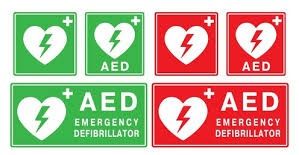
- Clearly signed — green AED signage with the heart-and-lightning-bolt symbol
- Never locked away in a cupboard or storeroom
In Australia, AEDs placed in public areas can also be registered on apps like GoodSAM and AED Locations Australia, which alert trained bystanders in your vicinity to cardiac emergencies.
The Cost of Not Having One
Consider the numbers:
- Survival rates for out-of-hospital cardiac arrest without defibrillation: 5–10%
- Survival rates when a bystander uses an AED within 3–5 minutes: up to 70%
- Average cost of an AED: $1,500–$2,500 AUD
- Average cost of a workplace personal injury claim: tens of thousands of dollars
- The cost of a life: immeasurable
For most workplaces, the business case for an AED is straightforward.
Getting Started: A Practical Action Plan
- Assess your risk. How many people are on your premises? Is anyone at elevated cardiac risk? What are your emergency response times?
- Check your legal obligations. Contact your state's Work Health and Safety regulator or seek legal advice specific to your industry.
- Choose a reputable device. Look for TGA-listed (Australia) or FDA-cleared (US) devices.
- Register your AED. In Australia, register with the Ambulance Victoria AED Registry or your state equivalent so dispatchers can direct bystanders to your device.
- Train your team. Book a CPR + AED training session with a registered provider. Most sessions take 3–4 hours and can be done on-site.
- Set a maintenance schedule. Assign an AED coordinator, set calendar reminders for monthly checks, and calendar replacements before pads or batteries expire.
Final Word
An AED won't prevent a cardiac arrest. But it can be the single piece of equipment that bridges the gap between collapse and the arrival of paramedics — and that gap is often fatal.
Whether you're an employer reviewing your duty of care, or a family member whose loved one has a heart condition, the question isn't really "Do I need an AED?"
It's "Can I afford not to have one?"
Always consult your local Work Health and Safety authority and a qualified first aid provider for advice specific to your situation. AED requirements and recommendations vary by jurisdiction.