

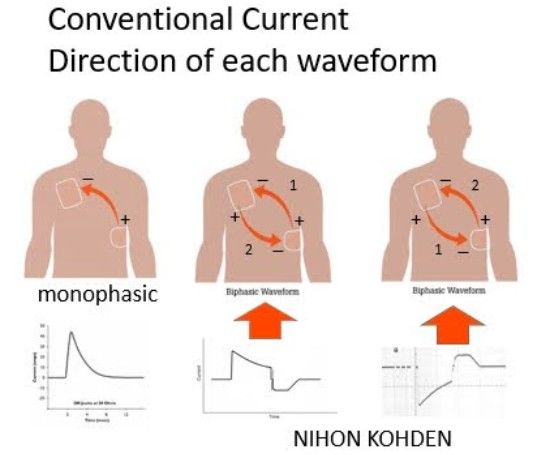
Second matter in saving a life. A defibrillator's waveform — the shape of the electrical pulse delivered to the heart — is critical because it determines both effectiveness and safety.
What the waveform actually does
The electrical pulse has to depolarize a critical mass of heart muscle cells simultaneously, essentially "resetting" the chaotic electrical activity (like ventricular fibrillation) so the heart's natural pacemaker can reassert a normal rhythm.
Why the shape matters
- Monophasic vs. biphasic: Older monophasic waveforms delivered current in one direction only. Modern biphasic waveforms reverse direction mid-shock. This turns out to be far more efficient — the heart is more responsive during the second phase, so the same result is achieved with significantly less energy (typically 110–200 Joules vs 360Joules).
- Energy efficiency: Less energy needed means less myocardial damage. Every joule above what's necessary risks burning cardiac tissue, causing post-shock dysfunction or even new arrhythmias.
- Impedance compensation: Chest impedance varies enormously between patients (body size, lung volume, electrode placement). Smart waveforms — particularly biphasic truncated exponential (BTE) and rectilinear biphasic designs — automatically adjust duration and amplitude to compensate, ensuring consistent current delivery regardless of the patient's chest impedance.
- Success rates: Clinical studies show biphasic waveforms achieve first-shock success rates of ~85–90% for ventricular fibrillation , compared to ~60% for monophasic. Fewer shocks needed = less total myocardial trauma.
The key parameters being optimised
| Parameter | Why it matters |
|---|---|
| Amplitude | Too low → no effect; too high → tissue damage |
| Duration | Affects how long cells are depolarised |
| Tilt/truncation | Controls how the pulse tapers off |
| Phase ratio | Balance between first and second phase in biphasic |
In summary, the waveform is the difference between a shock that reliably restores rhythm with minimal harm and one that either fails or injures the heart. It's why modern AEDs are so much more effective than earlier generations despite often using lower energy settings. CardioResus has a patented waveform that sets the new global breakthrough benchmark with defibrillators.