Women are half as likely as men to receive lifesaving defibrillation from a bystander during an out‑of‑hospital cardiac arrest. That single fact should stop us in our tracks. Cardiac arrest already kills fast — survival drops by about 10% per minute without defibrillation — and yet women face an additional barrier: hesitation.
Defibrillating Women: Closing the Survival Gap
When someone collapses from cardiac arrest, the heart stops pumping blood and oxygen. Every second counts. But emerging research shows that women aren’t just fighting biology — they’re fighting bias, uncertainty, and social discomfort.
The Gender Gap in Defibrillation
A major Victorian study analysing more than 32,500 cardiac arrests found that only 5% of women received bystander defibrillation, compared with 10% of men.
This disparity persists even though:
-
AEDs are safe and designed for untrained rescuers.
-
Good Samaritan laws protect bystanders acting in good faith.
-
CPR rates for women have improved significantly over the past two decades.
So why the hesitation?
Why People Hesitate to Defibrillate Women
Interviews with bystanders reveal three recurring concerns:
-
Fear of exposing a woman’s chest in public.
-
Fear of causing injury, especially due to breast tissue.
-
Fear of accusations of inappropriate touching.
These fears are understandable — but they are also deadly.
What Actually Matters in a Cardiac Arrest
Cardiac arrest is not a “wait and see” emergency. It is immediate, catastrophic failure of the heart. The only effective early interventions are:
-
CPR
-
Defibrillation
AEDs are designed to prevent mistakes:
-
They won’t shock unless the heart rhythm requires it.
-
They give step‑by‑step voice instructions.
-
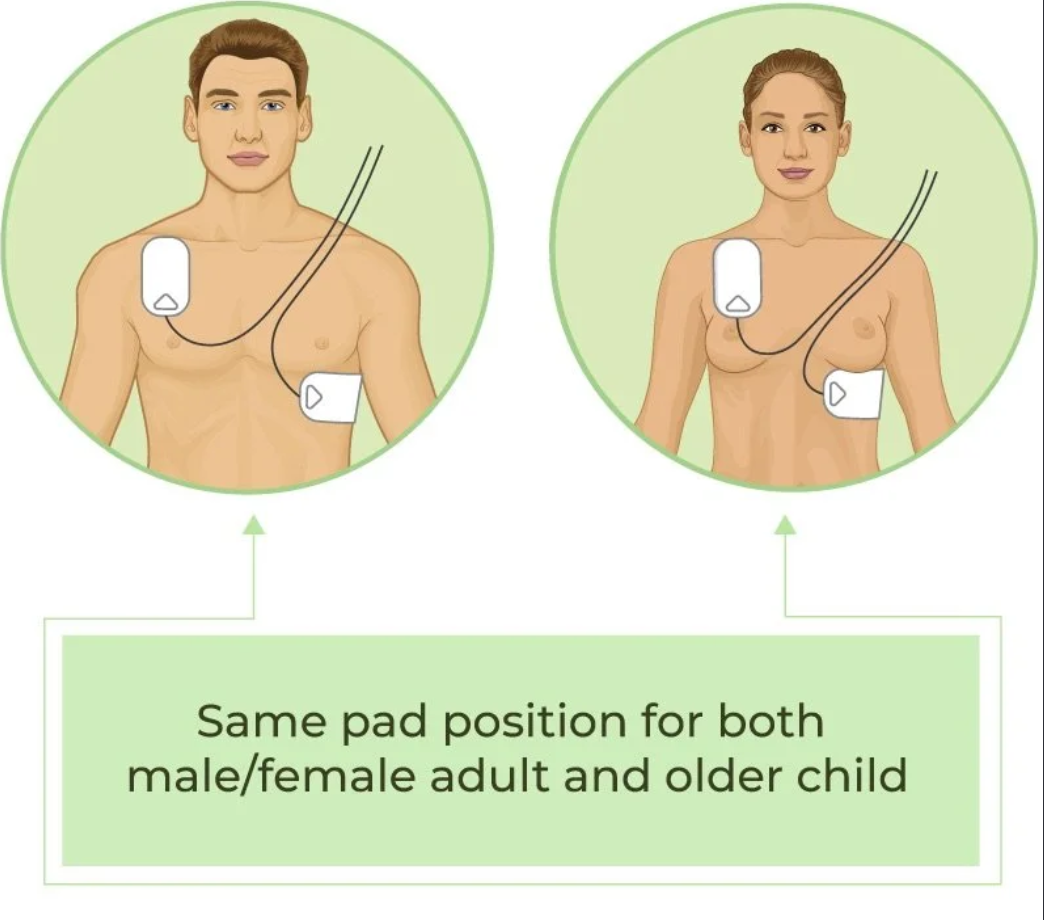
They guide pad placement, including on women.
Defibrillating Women: Practical Guidance
To defibrillate a woman safely and correctly:
-
Expose the chest — clothing, bras, and underwire can interfere with pad placement and shock delivery. A 2025 scoping review confirms that removing a bra is often necessary for proper pad placement.
-
Place pads exactly as shown on the AED diagrams:
-
One pad on the upper right chest
-
One pad on the lower left side
-
-
Follow the AED prompts — it will analyse the rhythm and tell you what to do.
This is not a moment for modesty. It is a moment for survival.
The Human Side of Hesitation
Many responders say they worry about “doing something wrong.” But as one first responder put it:
“When you’re in that situation, the bigger concern is life and death rather than modesty.”
If your mother, sister, partner, or friend collapsed, you would want someone — anyone — to act immediately.
How We Fix the Problem
1. Public education We must normalise the idea that defibrillating women requires chest exposure. It is not inappropriate — it is lifesaving.
2. Training and confidence building Even basic CPR training dramatically increases willingness to act. Programs like GoodSAM connect trained responders to nearby emergencies.
3. Clear messaging in AED instructions Manufacturers and public health organisations can emphasise pad placement on women more explicitly.
4. Community conversations Talking openly about this issue reduces stigma and fear.
A Call to Action
Women deserve equal access to lifesaving care. Cardiac arrest doesn’t discriminate — but our response often does.
If you see a woman collapse:
-
Call emergency services
-
Start CPR
-
Use the nearest AED
-
Expose the chest and place the pads correctly
-
Follow the prompts
Her life is worth more than her modesty. And your willingness to act could be the difference between life and death.